Dear colleague,
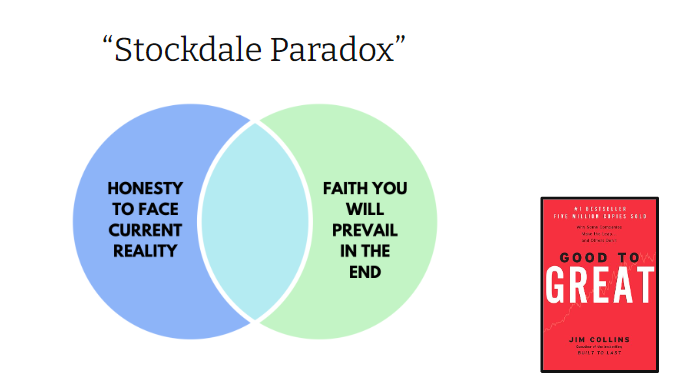
Today let's take a thinking tool called the Stockdale Paradox and see if it can help us with a common problem we face.
During my workshops on student motivation, I often get asked, “What about the students I have who are only motivated by grades?” This is an important question.*
All right — Stockdale Paradox time. First, let's face the brutal facts.
Brutal fact #1: Grade-obsession is a big problem. When a student is only motivated by how an assignment will affect their grade, what that student is telling us is, “School is meaningless.” It's “jump through X hoops to get Y treats so that someday, far away, I can do things that are actually important and meaningful.” In terms of genuine motivation for learning, that's a big miss.
So, take it seriously.
Brutal fact #2: Grade-obsession is painful. It is no fun to jump through hoops to get artificial prizes. It is no fun to experience high school as nothing more than four years of GPA-building so that I can go to the college I want to go to, or to experience middle school as staying on the honor roll so I don't get grounded, or what have you. Such conditions are antagonistic toward our students' souls. Student demotivation is experienced as pain.
So, approach this problem with compassion.
Brutal fact #3 (yay! just what we need): Though grade-obsession often begins in the home or in the personalities of our students, it is also something that grading systems reinforce just by existing. And I've found this to be true, by the way, in both traditional and standards-based grading systems. Both kinds of systems reduce student work into a letter or a number, and both systems, by existing, reinforce this idea that such a reduction is a sensible thing to do. So whichever grading system your school uses, remind yourself that what you're seeing in a grade-obsessed student is a pretty logical and even responsible response to the system.
Whew! Heavy stuff, amiright?
YES.
Heavy.
Good.
Let's shift now into unwavering faith. Hope time.
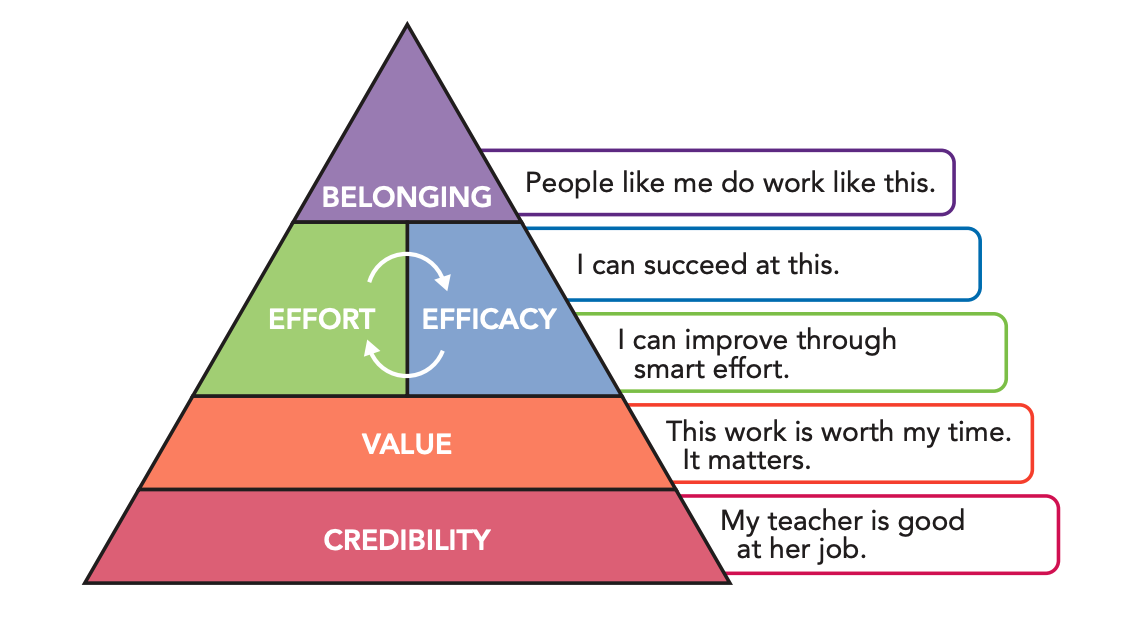
Good news #1: Grade-obsession is malleable. In terms of the Five Key Beliefs, grade-obsession is basically a problem with the Value, Effort, Efficacy, and Belonging beliefs.
Grade obsession sounds like:
- Value: The only thing important about school is getting good grades. That's an impoverished view of learning. But such views are malleable.
- Effort and Efficacy: If my definition of success is “getting an A,” difficult tasks or classes are going to threaten me. They'll demotivate me pretty quickly. What I need is a better definition of success, and I also need help interpreting my learning outcomes in a way that's more sophisticated than just “What grade did I get?” These are things a teacher can do.
- Belonging: If my identity is tied up in this idea of “being a straight-A student,” difficult tasks or classes are going to be a serious threat to me.
And this is actually really helpful information. It's good knows to gain a sense for how grade-obsession's inner voices sound. It can help us empathize with students, see their point of view, and aim for improvement.
Good news #2: Grade-obsession is something that any teacher can ameliorate over time, and this can largely be done through simple, repeated methods.
For example, start explaining this idea to students: “Master the material, and the grade will follow.”
I bet I say some version of “master the material” 500 times per class period per school year. I need to repeat it this often because it's a definition of success most secondary students are unfamiliar with. This intentional repetition helps clear the fog that obscures success for many students. Foggy definitions of success — or unhelpful ones that focus just on grades — are a leading cause of anti-Efficacy in students. This is why “Define Success: Wisely, Early, and Often” is one of only 10 strategies I unpack in The Will to Learn. It's a mission-critical teacher practice.
And finally, actually teach them how to master your course material. Lead them in regular practice toward mastery. Help them build knowledge. (After all: knowledge x practice x time = mastery.) Every task you give them ought to be directly aiming at mastering the course material or adjacent to that goal (e.g., an attempted Moment of Genuine Connection (MGC) isn't directly aiming at mastering course material, but it is aimed at cultivating Credibility and Belonging, which are both required for work toward mastery to be student-driven).
I could give more ideas — e.g., Unpack Outcomes, Good or Bad; Everest Statements; Woodenization; “It's not Personal; It's Business” — that help lessen grade obsession over time. But the point of this article is just that, if you're seeing this in your students:
- Yes, it's a problem.
- Yes, it is something you can ameliorate over time.
You can count on it.
Don't lose heart. Keep at it. You are just the person your grade-obsessed student has been waiting for.
Teaching right beside you,
DSJR
*P.S. So good, actually, that it's one of the 30+ “common hang-ups” I treat in The Will to Learn (pp. 120-122, check it out).
Pamela Leighton Volker says
Where can I find a good definition of true mastery when it comes to Kindergarten through 8th grade students?? I am often flabbergasted when I have seen Middle School students write incomplete sentences and poorly structured paragraphs when I know that they had “mastered” the art of writing complete sentences and properly-structured paragraphs while in the lower grades.